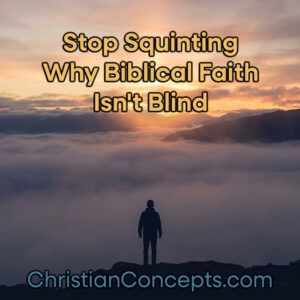
We often hear the phrase “blind faith” used as if trusting God requires us to close our eyes and take a reckless leap into the dark. But biblical faith isn’t blind. It doesn’t ask you to shut down your mind or ignore reality. Faith simply means operating by a different set of senses—trading physical optics for spiritual vision.
Physical Sight or Spiritual Faith?
Anyone who has tried navigating a pitch-black bedroom at night knows the reality of physical darkness firsthand. You creep across the floor, hands outstretched, trying not to disturb your sleeping spouse, only to bang your toe against a dresser you were certain was two feet to the left.
In those moments, a curious question arises: would it be easier to navigate if you could see just a tiny bit, or not at all?
Instinctively, we assume a little light is better than complete darkness. But partial light carries its own trap. When we see dim outlines, we are tempted to squint, guess, and double down on our own self-reliance. We lock our focus onto shadows, convinced we can engineer our own path if we just strain a little harder. In a spiritual context, partial physical vision often breeds self-effort, distracting us with visual noise. We end up focusing so heavily on what little we think we see that we forget to consider our new native seeing ability: faith.
To the worldly person, the visible appears solid and reliable, while the spiritual seems suspect and uncertain (2 Corinthians 4:18). Yet God grants spiritual sight, healing blindness so that discerning believers understand that the unseen holds eternal stability, while the visible proves fleeting and temporary. This clarity and conviction grounds and assures believers so they can act with “trusting faith”—far removed from the “blind faith” of the world.
Sometimes, God allows physical sight to fail—or renders what we see entirely irrelevant—so that we finally stop squinting. When you realize your physical vision offers no useful answers, you are finally ready to activate your spiritual eyes.
By Faith not by Sight
Scripture reminds us that we “walk by faith, not by sight” (2 Corinthians 5:7). This isn’t a call to walk blindly, but a shift in perspective. Physical eyes observe temporary, fleeting circumstances, whereas spiritual eyes perceive the unseen, eternal reality of God’s presence and promise (Hebrews 11:1). As Jesus pointed out, it is entirely possible to have perfect physical vision and yet remain spiritually blind—looking without ever truly seeing (Matthew 13:10–13, Mark 4:12).
When God asked Abraham to journey into the unknown, Abraham didn’t move forward because the physical path made sense; it didn’t (Hebrews 11:8). Likewise, when Moses stood against the power of Pharaoh, he persevered not because the visible circumstances were in his favor, but because he saw “Him who is invisible” (Hebrews 11:27). They walked forward because their spiritual eyes were fixed on the trustworthiness of the Creator (Proverbs 3:5–6).
True faith is not stepping blindly into a void. It is choosing to rely on spiritual reality when physical sight is useless or misleading. To human pride, abandoning physical control feels uncomfortably vulnerable. But to a humble heart, it yields a blissfully peaceful surrender. You no longer have to strain to figure out the dark—you simply rest in the care of the One who sees all things clearly.
Questions About Faith
Consider these questions to help you appreciate your faith.
- What does “walk by faith, not by sight” mean?
- How does the world define “blind faith”? How is this different from biblical faith?
- What are some things you can only see with spiritual eyes?
- What might you be relying on that is actually temporary and fleeting?
- What might you need to rely on that is actually solid and permanent?
Learn more about relying on your spiritual eyes or about looking but not really seeing (Matthew 13:10–13).
Image created by Matt using Gemini.
Last updated 20260906

Matt Pavlik is a professional counselor, author, and devoted follower of Christ. With decades of experience in Christian counseling, he writes with theological depth and everyday clarity. His resources—centered on salvation, identity, marriage, and emotional healing—are anchored in Scripture and guide believers to discover the freedom of their identity in Christ and the security of their salvation in Him. He and his wife Georgette, married since 1999, live in Centerville, Ohio, and have four adult children.



I think this is what is happening to me. I am truly manifesting physical responses also. My eyes are actually reacting too. Swelling and bleeding. Strangeness. This is another time I have to trust that God will get me through another difficulty. God bless you.