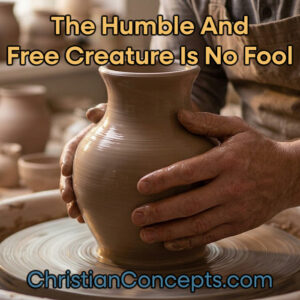
We rarely use the word “creature” to describe ourselves anymore. It can sound diminishing, as if being labeled a creature strips away our human dignity. Reclaiming the truth of your creaturehood, however, is actually one of the most liberating steps you can take. To admit that you are a creature is simply to acknowledge a fundamental reality: you are not the Creator.
There is tremendous emotional relief in that distinction. You do not have to hold the world together. You don’t have to manufacture your own truth, maintain ultimate control, or carry the crushing weight of self-creation. God designed you as a creature that depends on Him. When you accept your identity as a created being, you are finally allowed to put down the burden of trying to be God and rest in the care of the One who actually is.
Humble Creature or Godless Fool
Accepting yourself as a creature is an act of humility. This means insisting you were not created is an act of prideful folly. Notice how Isaiah captures the absurdity of this stance:
How foolish can you be?
Isaiah 29:16 NLT
He is the Potter, and he is certainly greater than you, the clay!
Should the created thing say of the one who made it,
“He didn’t make me”?
Does a jar ever say,
“The potter who made me is stupid”?
Consider how David uncovers the heart:
Only fools say in their hearts,
Psalm 14:1 NLT
“There is no God.”
They are corrupt, and their actions are evil;
not one of them does good!
In biblical Hebrew, fool (nabal) doesn’t mean someone who lacks mental intelligence. It refers to a person who is morally arrogant and acts as if they are accountable to no higher authority. To say “there is no God” is ultimately an act of pride—it’s declaring oneself to be the ultimate authority, accountable to no Creator. Notice David writes that the fool says it in his heart. It isn’t just an intellectual position; it’s a desire for absolute independence—a refusal to accept the humble position of creaturehood.
Denying the Creator isn’t intellectual enlightenment; it is spiritual arrogance and folly. Self-proclaimed autonomy ignores all that we start life with, leading to serious emotional consequences.
The Hidden Damage of the “Random Occurrence” Mindset
Contrast the peace of being a creature with the narrative dominant in our culture today: the lie that you are nothing more than a random biological accident. We are told we are the product of pure chance—a chaotic convergence of evolutionary luck and physical timing.
While this view is often framed as ultimate autonomy, it inflicts deep, hidden damage on the human soul. If you believe you are a random occurrence, then your worth, purpose, and identity become an exhausting do-it-yourself project. You are forced to invent meaning out of thin air and constantly perform to justify your existence.
If no one intentionally made you, then no one is responsible for defining who you are except you. That mindset turns life into a relentless treadmill of striving, driving chronic anxiety, self-doubt, and the terrifying fear that if your performance stumbles, your value disappears entirely. You can’t ever know if you are complete (good enough).
If you are a non-believer reading this, then consider your desire to seek meaning. Where does this desire come from? If you are random, then any “meaning” can only be self-determined. But even this meaning, if it is valid, had to come from somewhere. Did you start with a blank slate, or did you start with some predetermined desires and attributes? Everybody wants to understand who they are. If you didn’t determine your DNA, personality, and identity, then who did?
A desire for meaning, dignity, and value means you are more than an animal. But your inability to determine your own attributes from nothing means you are less than God.
Intentional Design Over Biological Chance
The root of this existential confusion often stems from our limited human perspective. Because our memories only stretch back to early childhood, we naturally measure our existence starting from our birth certificates. We look at our parents, our family history, and our genetic inheritance, assuming that biological conception is where our story began.
While human parents are the physical instrument, God is the intentional Author. You were not merely passed down through DNA or brought into the world by accident. Long before your parents ever conceived you, God willed you into existence on purpose.
Being created means that intentional design precedes birth:
- Value Is Built-In: An artist never crafts a masterpiece without intent. Because your Creator deliberately brought you to life, your worth is objective, secure, and built-in—completely independent of your performance or human approval.
- Identity Is Given, Not Constructed: You don’t have to bear the burden of inventing who you are; you receive your identity directly from the One who fashioned you. God is a more capable designer of you than you would be.
- Purpose Is Discovered, Not Forced: You don’t have to manufacture a reason to exist. Your purpose was woven into your design before you ever drew your first breath.
You are neither a surprise to the universe, nor a cosmic accident. You are a creature intentionally made by a loving Creator—and in that truth lies the freedom to stop striving and finally rest in who you were created to be. Learn more about being created in love.
Image created by Matt using Gemini.