• Skip to main content
  • Skip to primary sidebar
  • Skip to footer

Christian Concepts

Salvation, identity, and relationships are all secure in Christ—Discover God's truth and find emotional healing through deep soul care.

  • Start
  • Salvation
  • Identity
  • Marriage
  • Healing
  • Subscribe
  • About
    • About
    • Contact

Archives for March 2019

Break Free From Suffering Needlessly

Break Free From Suffering Needlessly

March 30, 2019 by Matt Pavlik 3 Comments

Everybody suffers. Some suffering is necessary while other suffering is needless. If I told you I am suffering needlessly, what adjectives would you use to describe me? Perhaps you’d think I was foolish or masochistic?

Jesus suffered, but not needlessly. There is a time to stay the course and suffer and there is a time to choose an alternate plan. Here is one way to define a balanced, healthy love:

Love does not suffer needlessly but neither does it run from suffering when running would be a denial of love. A loving person walks away from harm when possible and stays and faces harm when that is the only way to be loving.

Emilie Calabrese

Take a moment and reflect on your current suffering. Can you separate out which suffering is necessary and which is needless?

Needless Suffering is Self-Inflicted

Some suffering is avoidable. We suffer because of evil, its destructive deeds, and sin. Others can cause some of these deeds, but other destructive behaviors are self-inflicted.

Self-inflicted pain can be anything from actually cutting your body to agreeing with psychological put-downs such as, “I’m not enough” or “I’m disgusting.”

It’s easy to want to give up all hope when evil must co-exist with good (our present reality). God made us to desire complete beauty, not distorted beauty. But beauty remains even when part of it is missing. A puzzle with a hopeful message, even though it has some missing pieces, can still inspire hope. Beauty, even with some blemishes, fully retains its identity as God’s inspirational instrument.

Necessary suffering is God-ordained while needless suffering is self-inflicted. Share on X

Our world is not without good even though it has some evil mixed in. Despair is needless suffering because it focuses on the bad news as if it were stronger than the good news. Suffering will always be a part of this life, but you don’t need to give it more power than it has on its own.

Needless Suffering is a Form of Learned Helplessness

A mid-life crisis can involve coming face-to-face with the need to grow up. Instead of pressing forward, you decide to run away, refusing the opportunity for growth. Of course, then, the only way to go is backward so your behavior starts to look like it did when you were a child. Except now, if you have more power or money, you can create an even bigger mess.

Self-inflicted pain is really self-rejection, a form of learned helplessness. Share on Twitter

Learned helplessness is a cycle of defeat with no apparent escape. When people need to escape, but no escape is allowed, they can learn to accept feeling hopeless. Without hope, a genuine exit will feel no different than an impassible wall.

A bird in a cage learns what is possible and what is impossible. If the bird truly believes, “there is no escape,” then even when the cage door opens, the bird will not leave. The cage may be too comfortable or the outside too foreign.

Likewise, you can feel so negative for so long that you become numb. Then you can reach the point where it is normal to feel numb.

In this way, you can learn to turn off your emotions because they don’t seem to be of any help. But emotions are not the bad guy. Even the circumstances are not a catastrophe. The learned sense of hopelessness is the worst of it all.

Working through difficult experiences and emotions becomes the bridge of escape. But the bridge can appear to be too scary to cross. Instead of crossing the emotional bridge, you remain “land-locked.” The bridge forward is visible but might as well be invisible because the thought of making it across seems unbelieveable.

Needless suffering results from refusing to cross the bridge. Crossing the bridge might also be painful, but it leads to a better place.

Read more about emotions as a bridge to health.
Image by Martin Redlin from Pixabay
Last updated October 2, 2022


Filed Under: Healing in Christ, Abuse and Neglect, Emotional Honesty Tagged With: suffering

Is Emotion an Obstacle or a Bridge?

Is Emotion an Obstacle or a Bridge?

March 23, 2019 by Matt Pavlik 4 Comments

Does emotion hinder or does it help? To many people, emotion is a pointless burden. It seems to linger purposelessly forever like a plastic bottle in a landfill.

Obstacles impede progress. You must expend more effort to move beyond the obstacles in your path. Some obstacles cannot be removed by your effort alone.

Bridges on the other hand smooth the journey. Someone already cleared the path which makes your end goal possible and maybe easier. Although, some bridges are challenging to cross. The journey is strenuous, not because of the path, but because of what must be left behind.

Whether the emotion is a positive experience for you or a negative one, depends on your perspective. Rocks in your pack can be considered an affliction, but they could also be a blessing in disguise–they can help you grow stronger so you can move obstacles out of your way. What seems like an obstacle one day, might eventually come to be seen as a benefit.

Emotion is Like an Obstacle

Emotion is never bad; it’s only the messenger. We’re not supposed to shoot the messenger. But what is a person to do when the message is overwhelmingly negative? When emotion is immobilizing, it acts like an obstacle to progress. But it really is only a pivot point loaded with potential.

A person can lean into the negative message and become all the more discouraged. A person can also block out the message. Rough, calloused hands and fingertips are a sign of hard work. Your body forms a protective layer while you get work done.

In an emotionally risky environment, it’s natural to develop an insulative layer to protect your heart. Some negative environments you can avoid completely. And you should. But in other environments, you can’t.

Everyone is going to have some emotional callousness. Adam and Eve became overly defensive after the fall. Over-protection is a tendency we all have to work at overcoming.

You have an automatic defense system that sometimes malfunctions.

Sometimes your defensive system protects you so well that you don’t even know what it’s protecting. I’m lost; I don’t know who I am. At other times, you’re surprisingly vulnerable. Why am I flooded with emotion now?

Emotion is Like a Bridge

Because God exists, hope exists. No circumstance can determine the final outcome of your life. Because of God, emotion, even discouragement, can be productive.

Everything has a purpose–even negative feelings. You can’t avoid all risky environments because there’s no heaven on earth. So the best anyone can do is commit to crossing the emotional bridge.

Emotion can always become a bridge to a better place. That bridge can look like an obstacle, at first glance. Maybe you aren’t ready to leave behind what is comfortable, whether that be numbness or negativity. Maybe you aren’t ready to find out who you are deep down.

Crossing the bridge means embarking on a journey to becoming alive.

The obstacle to a better future is refusing to leave behind the past. You can only escape past and present pain by crossing the bridge of emotion. As you feel what you’ve experienced, it will carry you forward.

God didn’t make us to journey alone. We need traveling companions to help ease the pain of seeking true living that God has planned for us. Avoiding future pain is wise… unless that pain is needed to make you into a better person. Or perhaps the better way to put that is becoming a better person always involved confronting your pain.

If you’d like to better understand how difficult emotions can be blessings, try the book Hind’s Feet on High Places by Hannah Hurnard.

Read about choosing healing instead of coping.
Image by Larisa Koshkina from Pixabay
Last Updated 2022/10/16

Filed Under: Emotional Honesty, God's Kingdom, Healing in Christ Tagged With: lost, numb, overwhelmed, panic, purpose, suffering

Understanding: The Struggle To Find Peace

Understanding: The Struggle To Find Peace

March 16, 2019 by Matt Pavlik Leave a Comment

Is Understanding a Blessing or a Curse?

What is normal can often go unnoticed. Like the hum of a refrigerator or the weight of the air, our internal state becomes the background noise of our lives. When you are in a season of hardship, your thoughts often switch to autopilot. You spend your days—and often your nights—investing every ounce of your brain’s computing power into analyzing the confusion and sadness you’re going through.

You’ve dedicated your full computing power to solving the puzzle of your life. But what if all that mental effort is actually unnecessary? What if there is a simpler solution than “figuring it out”? Here is a perspective shift that might feel like cold water on a tired face: your efforts to understand every “why” might actually be the thing keeping you from finding peace in the middle of a struggle.

Stop Leaning on Your Own Understanding

We often believe that if we can just solve the mystery of our circumstances, the anxiety will stop. We think that “Knowledge = Peace.” However, your perspective on your current situation is likely missing critical pieces of data. God has those missing pieces, and He often holds them until the moment they are actually required.

Proverbs 3:5 famously instructs: “Lean not on your own understanding.” Yet, just a few verses later, Proverbs 3:13 encourages: “Get understanding.” At first glance, this feels like a contradiction. Is understanding a virtue or a trap?

The distinction lies in the source. God isn’t telling you to avoid all logic or wisdom; He is saying that your limited perspective can become a cage. You gain His understanding as—or often after—you walk in faith. Real insight is rarely found in the heat of the moment; it is a gift that often arrives in hindsight, once you have moved through the difficulty.

Accepting the Struggle As Is: A Pathway to Peace

Most people are familiar with the Serenity Prayer, but we often treat it like a greeting card sentiment rather than a survival manual. To find peace in the middle of a struggle, we have to look closer at the wisdom Reinhold Niebuhr penned:

God, grant me the serenity to accept the things I cannot change, the courage to change the things I can, and the wisdom to know the difference.

This shortened version is about setting firm boundaries for your understanding. It’s about recognizing which parts of your life are already fixed by time or circumstance and which parts are open to your agency. If you are using your energy trying to change a reality that is beyond your control, you are depleting the very resources you need to survive today.

The full version of the prayer takes it deeper:

Living one day at a time, enjoying one moment at a time; accepting hardship as a pathway to peace; taking, as Jesus did, this sinful world as it is, not as I would have it; trusting that You will make all things right if I surrender to Your will; so that I may be reasonably happy in this life and supremely happy with You forever in the next. Amen.

Peace isn’t found by rearranging the world so it matches your desires; it’s found by accepting the world “as it is” and trusting in a sovereign God who is already at the destination. For more on how to manage the mental clutter that prevents this kind of surrender, you can explore my guide on overcoming identity clutter.

Understanding The Problem

When you are overwhelmed, your brain asks: “How do I fix this?” But that might be the wrong question. If you are afraid, do you know what you’re really afraid of?

Often, we aren’t afraid of the problem itself; we are afraid of the uncertainty that comes with it. We are afraid that if we don’t understand the plan, then there is no plan. We treat our lives like a high-stakes gamble that could go wrong at any moment. But for the traveler who belongs to God, the end of the story is already written, and it is good.

To find peace in the middle of a struggle, you must stop trying to engineer the outcome and start listening for the quiet prompts of the Spirit in the present. Are you treating your history as a list of failures, or as a library of lessons? When you realize that your past has equipped you and your future is secure, the pressure of the present moment begins to lift.

Finding Peace Beyond Understanding

You don’t need life to make sense to have peace. You just need to be quiet enough to recognize the next step. God’s map for your life is already drawn, and the light is already hitting the path. You don’t have to create the light; you just have to stop closing your eyes to it by obsessing over your own limited understanding.

If you feel like you’re losing your way, remember that you are never truly adrift. You are simply in a high-pressure middle ground where your true self—the one that exists apart from your mistakes or your fears—is being revealed. Take a breath. Stop the autopilot thoughts. Surrender the need to know “Why,” and ask God for the “What now?”

The path forward isn’t a secret code you have to crack; it is the natural result of standing on the solid ground of your faith while keeping your eyes on the promise of restoration.

Task for Today: Identify one thing today that you have been trying to “analyze” to death. Practice accepting what you cannot change and ask God for the peace that surpasses your current ability to understand.

Image created by Matt using Gemini.
Last updated: 20260412

Filed Under: Identity in Christ, Emotional Honesty, Healing in Christ, Self-Care Tagged With: anxiety, despair, serenity, worry

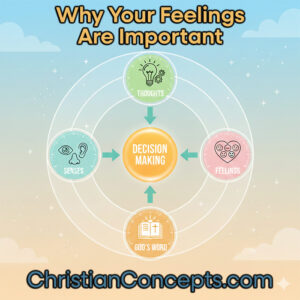
Biblical discernment dashboard showing feelings as information.

Why Your Feelings Are Important

March 9, 2019 by Matt Pavlik 2 Comments

Learn how to treat your feelings as vital data points and partner them with Biblical truth to make healthier, more discerning life decisions.

Your emotions are part of the complete package God provided. You have a body with five senses, you have thoughts, and you have feelings. None of these exist in a vacuum; they are designed to work together to help you navigate a complex world.

There isn’t anything wrong with your feelings. However, problems arise when we either ignore them entirely or interpret them as absolute commands. To live a discerning life, we must learn to see feelings as Information, not Instruction.

Feelings as Internal Senses

Your feelings provide information just like your physical senses. If something smells bad, you use that information to help you make a decision. If you smell smoke, your “smell data” suggests there might be a fire.

The trouble starts if you bias the information to favor the decision you want to make. If you want to stay in a warm house despite the smoke, you might try to convince yourself the smell isn’t objective. Conversely, if you overly value a single sense, you miss out on the full reality. Some foods smell bad but are actually good for you. Some foods have a strange texture but taste wonderful. If you prioritize texture above all else, your “data” is incomplete.

Our emotions work the same way. They are like a dashboard in a car—the “Check Engine” light isn’t the problem; it’s simply a report on the state of the engine. We must understand that emotions are never sinful, while also realizing they are only one part of the dashboard.

The Brownie Bias: Decoding Your History

When I was a child, I had some bad food experiences with brownies and roasted pumpkin seeds on separate occasions. To this day, I sometimes feel queasy before I eat these foods.

My feelings are giving me “data”: Danger! This made us sick before! But unless all brownies in the world are poisoned, my feeling is biased. It’s a “false positive” based on past pain. If I let that feeling be my only instructor, I miss out on a perfectly good dessert.

We all have “Brownie Biases” in our relationships and spiritual lives. A past hurt might make you feel “queasy” about trusting a new friend or a new church. In those moments, you have to ask a difficult question: Should these feelings be trusted or discounted? Is the feeling a valid warning, or is it just an old memory ringing an alarm bell?

Fact vs. Fiction: The Art of Discernment

God made your feelings, so they must be important. They are meant to work in partnership with your other senses and your intellect. Then, through your ability to discern fact from fiction, you can correctly interpret all the input you’ve gathered to make a godly decision.

Life becomes interesting when strong feelings come into conflict with the truth. This is the exact tension Adam and Eve faced in Genesis 3. Eve felt the fruit was desirable; she saw it was pleasant. Her sensory data was screaming “Yes!” but God’s word had said “No.”

Deception often thrives in the gap between what we feel and what is true. When these two are in conflict, we have to decide which one to prioritize. Sometimes, we must lean on the truth to lead our feelings; other times, a “negative” feeling is actually God’s way of pointing us toward a truth we are trying to ignore. In fact, there are 2 helpful no-guilt negative emotions that are specifically designed to lead us back to a right path.

Reflection and Application

Your emotions aren’t an obstacle to a spiritual life; they can actually be a bridge to a deeper understanding of yourself and God. But to use that bridge, you must be willing to look at them objectively.

As you go through this week, reflect on the “data” your heart is sending you:

  • Check the Bias: Have you ever been absolutely sure of something because of a “gut feeling,” only to find out you were wrong? What was the bias behind that feeling?
  • Consult the Dashboard: Are you treating your feelings as Information (something to be weighed) or Instruction (something that must be obeyed)?
  • Bridge or Obstacle: In your current situation, is your emotion an obstacle or a bridge to the truth?

God wants the “complete package” of who you are—body, mind, and spirit—to be aligned with His truth. Don’t be afraid to consider all the data God has provided.

Last updated 20260215
Image created using Gemini

Filed Under: Emotional Honesty, Healing in Christ, Identity in Christ

Enjoy A New Reality

Enjoy A New Reality

March 3, 2019 by Matt Pavlik 1 Comment

Have you ever failed to keep a new year’s resolution? Have you ever reached your goal weight only to gain back those pounds?

In these situations, without the possibility of a new reality, you’re going to feel hopeless. Something needs to change if you want to continue to feel hopeful. But it’s even more than that. You’re only going to be as hopeful as your changes are permanent.

This is part 3 of Sean’s healing journey.

Sean’s New Reality

I ended part two of Sean’s story with him receiving a new bicycle from his small group. This experience, led by God, allowed the truth of the scriptures to sink into his heart. Now he could not only say that he knew the truth as a fact, but he knew the truth as a reality.

This is how we know what love is: Jesus Christ laid down his life for us. And we ought to lay down our lives for our brothers and sisters. If anyone has material possessions and sees a brother or sister in need but has no pity on them, how can the love of God be in that person? Dear children, let us not love with words or speech but with actions and in truth.

1 John 3:16-18 NIV

Pursue Your New Reality

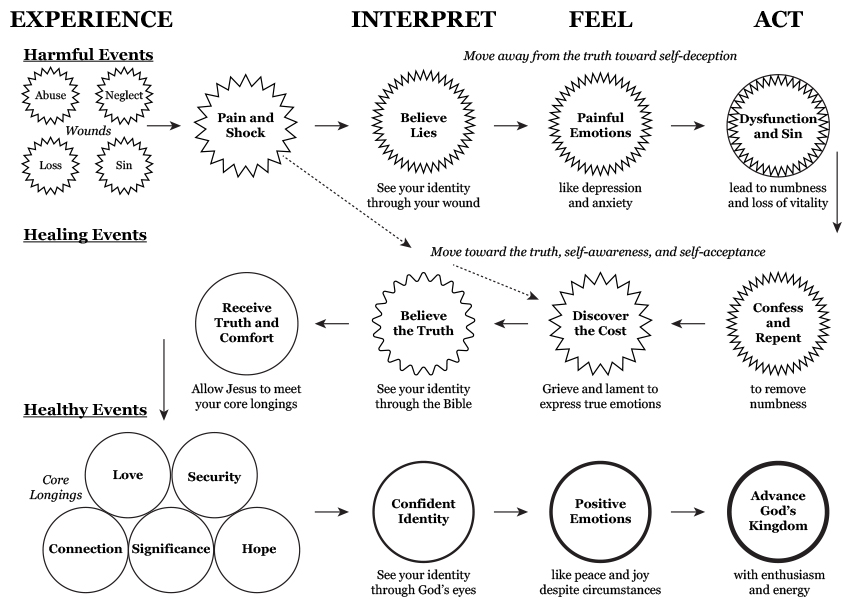
Sean’s story illustrates that your experiences shape the way you view your identity. Your interpretation of your experiences can be accurate or inaccurate. When you go through a negative experience without a positive experience to counter-act it, the negative experience will dominate your understanding of who you are.

If you’ve gone through a time of discovering the truth, you’ll know the factual truth about your identity. Unfortunately, this isn’t enough. You must go one step further to experience a positive event that can override the negative event. Only then can you know the truth about your identity. You’ll see yourself properly, through God’s eyes.

How you interpret the events affects your long-term feelings about life. If you’re feeling depressed or anxious, it’s probably because of a negative interpretation of a negative experience. Without a positive intervention that allows you to see the truth, you might pursue destructive behavior toward yourself or others.

Review the diagram below which illustrates how a person can move from a hurtful event, to a healing process, and onto a new reality. I regularly use it with my clients to help them see how their lives became dysfunctional and how they can return to healthy living. See if you can trace Sean’s experiences through the diagram, then try an example from your own life.

How To Experience The New Reality of Emotional Healing

A New Reality Is Possible

Personal transformation occurs on multiple levels. To illustrate this, consider what happens when you change your appearance by putting on a different set of clothes. You could change from wearing plain, worn clothes to stylish, brilliant clothes.

Is that enough to change how you feel about yourself? It might help some, but chances are, any improvement will be short-lived. Changing your clothes doesn’t really change who you are, even though others will certainly see you differently.

Do not conform to the pattern of this world, but be transformed by the renewing of your mind. Then you will be able to test and approve what God’s will is—his good, pleasing and perfect will.

Romans 12:2 NIV

The process of renewing your mind found in Romans 12:2 involves a real change in brain structure. New positive experiences rewire your brain. As a result, you might be motivated to change how you dress or pursue other outward manifestations of your inner healing.

Sometimes, you can help this process by changing on the outside first, which is also called fake-it-until-you-make-it. It’s better than nothing. But God’s Spirit working inside you is much more powerfully transformative.

Have you ever experienced this deep renewing? This true healing makes old thinking obsolete. Experiencing this transformation enables you to believe it can happen again. That’s one way to define true, biblical hope.

Once you understand how change happens, you can begin to make leaps forward. Instead of baby-steps, which often maintain too much of the old environment, you can leap forward to new ways of thinking that you didn’t know existed.

Are you excited about the possibilities of a new reality?

Read Part 1
Read Part 2
Photo from PxHere

Filed Under: Identity in Christ, Abuse and Neglect, Healing in Christ

Primary Sidebar

Recent Posts

  • Grow Your Ability To Love
  • Never Lost
  • Discover Your Shared Mission In Marriage
  • Already Eternal, Even When You Feel Useless
  • Contemplate Your Priorities To Prevent Spiritual Decay

Recent Comments

  • Grow Your Ability To Love - Christian Concepts on The Best Way To Receive Love
  • Grow Your Ability To Love - Christian Concepts on Fear of God: Repulsion, Rejection, or Respect?
  • Understanding: The Struggle To Find Peace - Christian Concepts on Never Lost
  • Deb on Never Lost
  • Never Lost - Christian Concepts on Restoration After Wreckage

Topics

  • Abuse and Neglect
  • Betrayal
  • Boundaries
  • Conflict Resolution
  • Core Longings
  • Dating to Find a Mate
  • Emotional Honesty
  • God's Kingdom
  • Healing in Christ
  • Identity in Christ
  • Marriage in Christ
  • Salvation in Christ
  • Secure in Christ
  • Self-Care
  • Self-Image

Archives

  • April 2026
  • March 2026
  • February 2026
  • January 2026
  • December 2025
  • November 2025
  • October 2025
  • September 2025
  • August 2025
  • July 2025
  • June 2025
  • May 2025
  • April 2025
  • March 2025
  • February 2025
  • January 2025
  • December 2024
  • November 2024
  • October 2024
  • September 2024
  • August 2024
  • July 2024
  • June 2024
  • May 2024
  • April 2024
  • March 2024
  • February 2024
  • January 2024
  • December 2023
  • November 2023
  • October 2023
  • September 2023
  • August 2023
  • July 2023
  • June 2023
  • May 2023
  • April 2023
  • March 2023
  • February 2023
  • January 2023
  • December 2022
  • November 2022
  • October 2022
  • September 2022
  • August 2022
  • July 2022
  • June 2022
  • May 2022
  • April 2022
  • March 2022
  • February 2022
  • January 2022
  • October 2021
  • September 2021
  • August 2021
  • July 2021
  • June 2021
  • May 2021
  • April 2021
  • March 2021
  • February 2021
  • January 2021
  • December 2020
  • November 2020
  • October 2020
  • September 2020
  • August 2020
  • July 2020
  • June 2020
  • May 2020
  • April 2020
  • March 2020
  • February 2020
  • January 2020
  • December 2019
  • November 2019
  • October 2019
  • September 2019
  • August 2019
  • July 2019
  • June 2019
  • May 2019
  • April 2019
  • March 2019
  • February 2019
  • January 2019
  • December 2018
  • November 2018
  • October 2018
  • September 2018
  • August 2018
  • July 2018
  • June 2018
  • May 2018
  • April 2018
  • September 2017
  • March 2015
  • February 2015
  • January 2015
  • December 2014
  • June 2012
  • April 2012
  • March 2012
  • January 2012
  • August 2011
  • July 2011
  • June 2011
  • May 2011
  • April 2011
  • February 2011
  • December 2010
  • November 2010
  • October 2010
  • July 2010
  • June 2010
  • May 2009
  • April 2009
  • March 2009

Footer

Follow

  • Facebook
  • LinkedIn
  • Pinterest
  • Twitter
Christian Concepts Logo

© 2003–2026 · New Reflections Counseling, Inc. · Christian Concepts Publishing · Privacy Policy